
News

Stay informed about AI innovation

Stay informed with the latest developments in technology, digital innovation, and AI. Our News section highlights key industry trends, regulatory updates, and breakthroughs relevant to your business.

News – AI Expands Enterprise Automation
15 March 2026

Enterprises Shift Toward Fully Integrated AI Strategies

Companies across Europe and the US are increasingly transitioning from isolated AI tools to fully integrated AI-driven business processes. Rather than deploying standalone solutions, organizations are embedding artificial intelligence into core operations such as logistics, customer service, and decision-making systems. This shift is driven by the need for measurable outcomes, with firms focusing on efficiency gains, cost reduction, and scalability. At the same time, governance and compliance are becoming critical, as companies must ensure transparency, data protection, and regulatory alignment in AI deployment.
SourceArtificial Intelligence News, Gartner
News – AI Market Competition Intensifies
15 February 2026

Global Competition in AI Accelerates Innovation Cycles

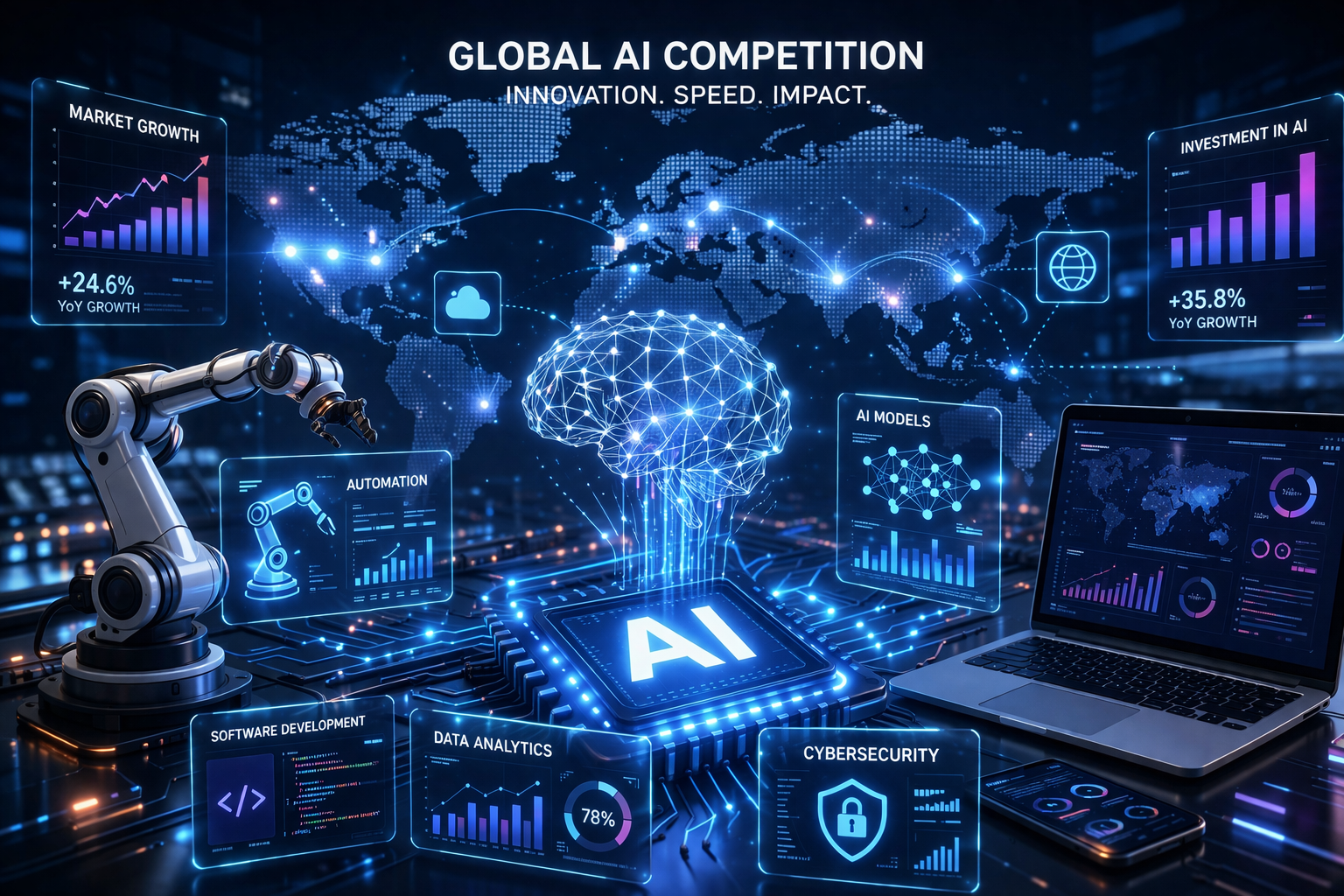
The global AI market is becoming increasingly competitive, with major technology companies and emerging startups releasing new models and platforms at a rapid pace. This intensified competition is accelerating innovation cycles, particularly in areas such as software development, automation, and data analytics. Companies are also focusing on industry-specific AI applications tailored to sectors like healthcare, finance, and manufacturing. At the same time, regulatory pressure continues to grow, requiring organizations to balance innovation with compliance and data security.

SourceMcKinsey, Deloitte Insights
News – Robotics and Physical AI Breakthrough
15 January 2026

Breakthrough in Robotics Marks Rise of Physical AI Systems

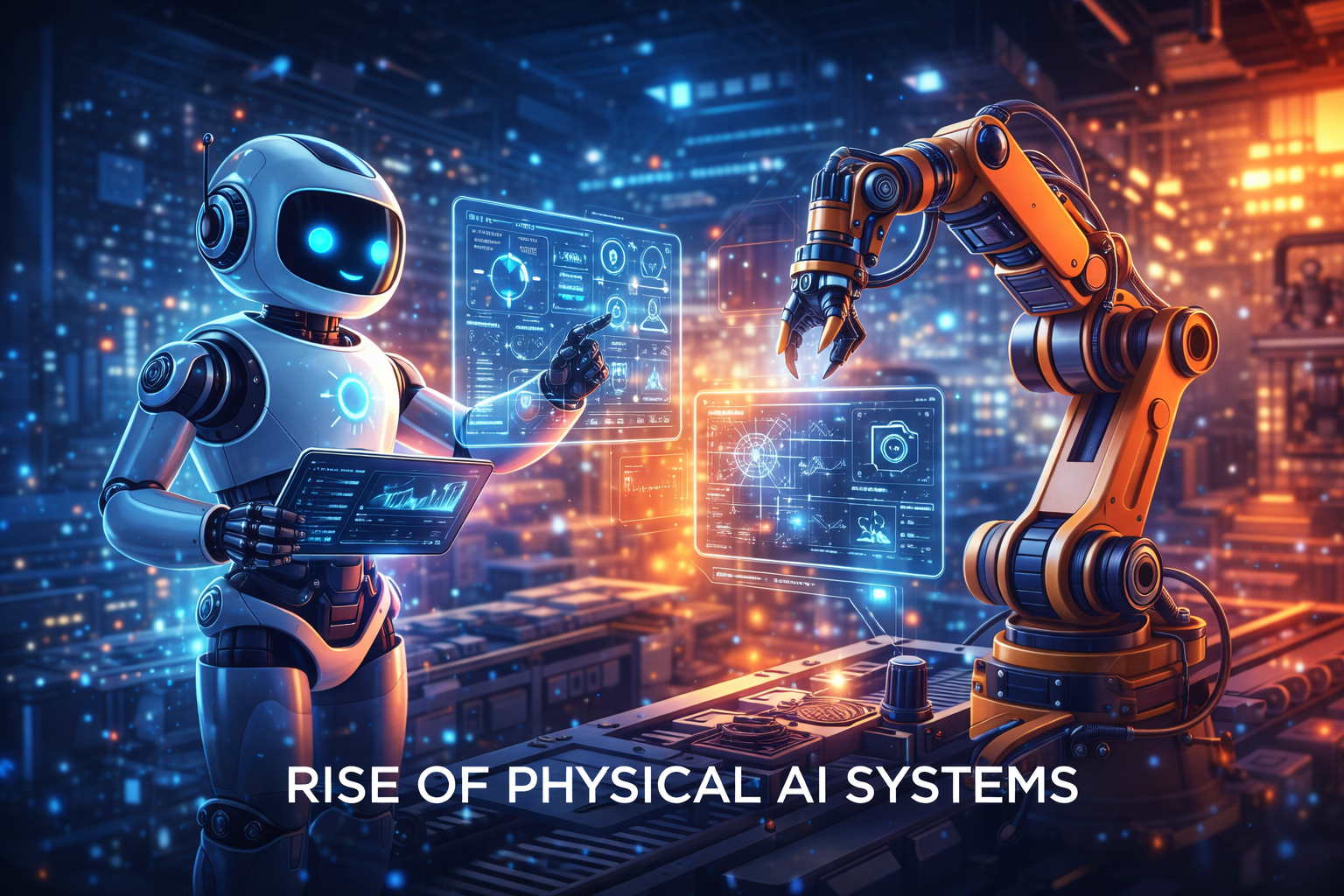
Recent developments in robotics and artificial intelligence signal a major transition from digital AI systems to physical AI applications. Companies showcased advanced robots capable of autonomous decision-making and task execution in real-world environments. These systems combine machine learning, computer vision, and sensor technologies to perform complex industrial and logistical operations. The breakthrough is expected to significantly impact manufacturing, warehousing, and infrastructure management, opening new opportunities for automation and efficiency gains.

SourceMIT Technology Review, IEEE Spectrum
News – AI Moves to Real-World Implementation
15 December 2025

AI Transitions from Experimentation to Real-World Execution

Industry reports indicate that artificial intelligence is entering a new phase focused on real-world implementation. Organizations are moving beyond experimental pilots and investing in scalable AI solutions that deliver measurable business value. Key areas of adoption include supply chain optimization, predictive analytics, and automated customer interaction. Experts emphasize that clearly defined use cases and integration strategies will determine long-term success, while discussions about an “AI bubble” continue to evolve into a focus on sustainable growth.

SourceInnovation News Network, PwC
News – AI Growth in E-Commerce and Software
15 November 2025

AI Drives Growth in E-Commerce and Software Markets

Artificial intelligence continues to reshape digital markets, particularly in e-commerce and software development. Businesses are increasingly leveraging AI-powered tools to enhance user experience, automate workflows, and optimize decision-making processes. Advances in generative AI models are enabling more personalized interactions and improved data analysis capabilities. Additionally, the emergence of agent-based systems is transforming how software is developed and operated, allowing for autonomous task management and increased efficiency across industries.

SourceForbes, TechCrunch
News – European CEOs Call to Pause AI Act
15 October 2025

European CEOs Call to Pause AI Act over Competitiveness Concerns

Prominent European corporate leaders—representing firms such as Airbus, BNP Paribas, and Philips—have urged the European Commission to pause the AI Act’s rollout, warning its complexity could stifle innovation and hamper the competitiveness of European tech. In an open letter, they highlighted legal uncertainty in classification rules and suggested that the regulation disproportionately favors large incumbents. The appeal underscores tension between regulatory ambition and market realities in Europe’s AI ecosystem.

News – AI Act Correspondents Network Holds Second Meeting
1 October 2025

AI Act Correspondents Network Holds Second Meeting

Over 100 representatives from across Europe convened—online and in Brussels—for the second meeting of the AI Act Correspondents Network. This forum fosters inter-agency cooperation, shared learning, and alignment of enforcement practices among national oversight bodies. The meeting’s agenda included updates on implementation status, coordination on high-risk definitions, and strategy for stakeholder outreach. It illustrates the growing importance of collaborative regulatory governance post-AI Act enforcement.

News – Quantum Supercomputer VLQ
15 September 2025

Europe Inaugurates Quantum Supercomputer “VLQ” to Boost Research Infrastructure

Europe has officially launched the quantum-class system VLQ in Ostrava, Czechia, marking a major leap in continental research infrastructure. Operated under the EuroHPC Joint Undertaking, VLQ integrates 24 superconducting qubits in a star topology, designed to link with classical high-performance computing systems for hybrid workflows. While calibration is still underway, the platform is set to support quantum algorithms, materials science, cryptography, and other advanced research. This development reinforces Europe’s commitment to building sovereign computing capabilities and fostering innovation at the quantum frontier.

News – EU Launches Apply AI Strategy
1 September 2025

EU Launches “Apply AI” Strategy with €1 Billion Funding

The European Commission has unveiled its “Apply AI” Strategy, backed by €1 billion to accelerate the adoption of trustworthy AI across European industries and research. The plan emphasizes strengthening European technological sovereignty within the regulatory framework and scaling AI use in sectors like healthcare, manufacturing, and climate technologies. It builds on earlier infrastructure and regulatory initiatives to position the EU as a hub of responsible innovation.

News – OpenAI Prepares Launch of GPT-5 with Hybrid Architecture
15 August 2025

OpenAI Prepares Launch of GPT-5 with Hybrid Architecture

According to reports, OpenAI is preparing to launch GPT-5 in early August 2025, integrating multiple underlying models for greater versatility and robustness. The design is expected to allow the system to switch between specialized modules depending on task demands instead of relying on a monolithic model. This hybrid approach may improve efficiency, adaptability, and interpretability compared to prior generations. The move is seen as a response to increasing demands for more modular, scalable architectures in advanced AI systems.

News – Digital Twin Cities Initiative
1 August 2025

Europe Advances Smart Infrastructure with “Digital Twin Cities” Initiative

The European Innovation Council has announced the launch of the “Digital Twin Cities” Initiative, a program designed to develop real-time, data-driven digital replicas of urban environments to optimize city planning, sustainability, and infrastructure management. The project brings together municipalities, technology firms, and research institutes from 12 EU countries. These digital twins will simulate energy flows, mobility systems, and climate resilience scenarios to guide smart decision-making and reduce emissions. The initiative is part of the EU’s broader Green and Digital Transformation Agenda, aiming to make European cities more adaptive, efficient, and sustainable by 2030.

News 16
15 July 2025

Germany Launches Ambitious “AI Offensive” for 2030 Growth

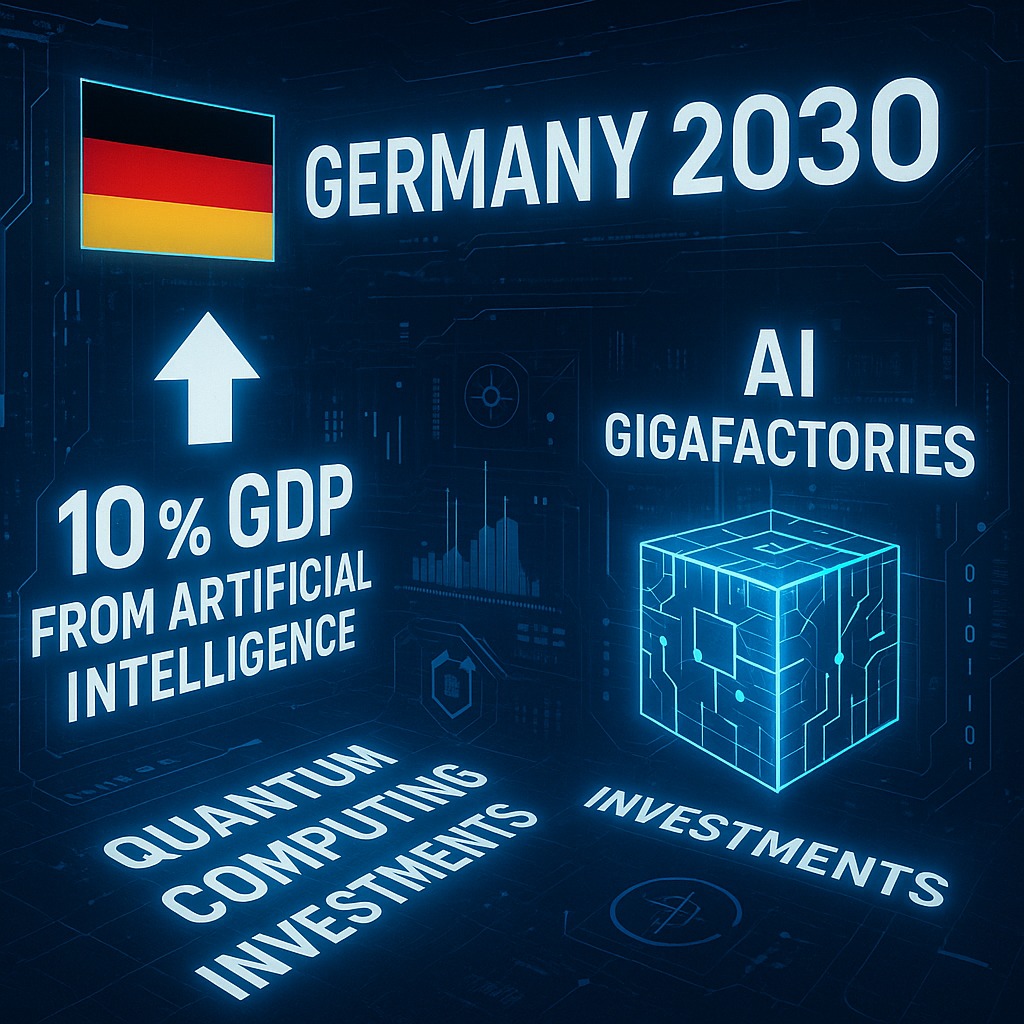
The German government has unveiled a national AI strategy aimed at making artificial intelligence a key economic driver by 2030. Dubbed an “AI offensive,” the plan targets 10% of Germany’s GDP to be AI-based by 2030, seeking to narrow the technology gap with the US and China. The draft strategy outlines investments in large-scale AI processing centers (“AI Gigafactories”) coordinated with industry and federal states. Brussels is backing infrastructure expansion with €20 billion earmarked by the European Commission for AI/data facilities. The German plan also sets goals in quantum computing (two error-corrected quantum computers by 2030) and emphasizes public-private cooperation. The Cabinet is expected to approve the strategy within the month, underscoring Germany’s commitment to AI-driven innovation.

SourceHandelsblatt, European Commission
News 15
10 July 2025

EU Code of Practice Guides General-Purpose AI Compliance

The European Commission has published a General-Purpose AI Code of Practice to help providers of large AI models align with upcoming EU regulations. Drafted by 13 experts with input from over 1,000 stakeholders, the voluntary Code offers guidelines on transparency, copyright, safety, and security for foundation-model AI. It supports compliance with the EU’s AI Act rules taking effect in August 2025, which will require makers of broadly-used AI systems to implement risk assessments and transparency measures. Companies that sign the Code and follow its recommended practices will enjoy greater legal certainty and reduced bureaucracy. This initiative reflects Europe’s push for responsible AI innovation, ensuring powerful AI models are safe, transparent, and trustworthy.

SourceEuropean Commission, TechCrunch, Euractiv
News 14
30 June 2025

Global Forum Urges Action on Ethical AI Cooperation

At UNESCO’s 3rd Global Forum on AI Ethics in Bangkok, international leaders called for turning AI ethics principles into concrete actions. The forum highlighted progress since UNESCO’s landmark 2021 AI Ethics Recommendation, noting that dozens of countries have begun integrating ethical frameworks and conducting AI readiness assessments. New global cooperation platforms were announced, including a Network of AI Supervisory Authorities and a civil society & academia network, to strengthen cross-border governance of AI. A key message was that international and regional collaboration is urgently needed to ensure AI develops in a human-centric, responsible manner. Officials stressed moving beyond principles: implementing oversight mechanisms and sharing best practices so that ethical guidelines lead to real-world impact.

SourceUNESCO, UN News
News 13
15 June 2025

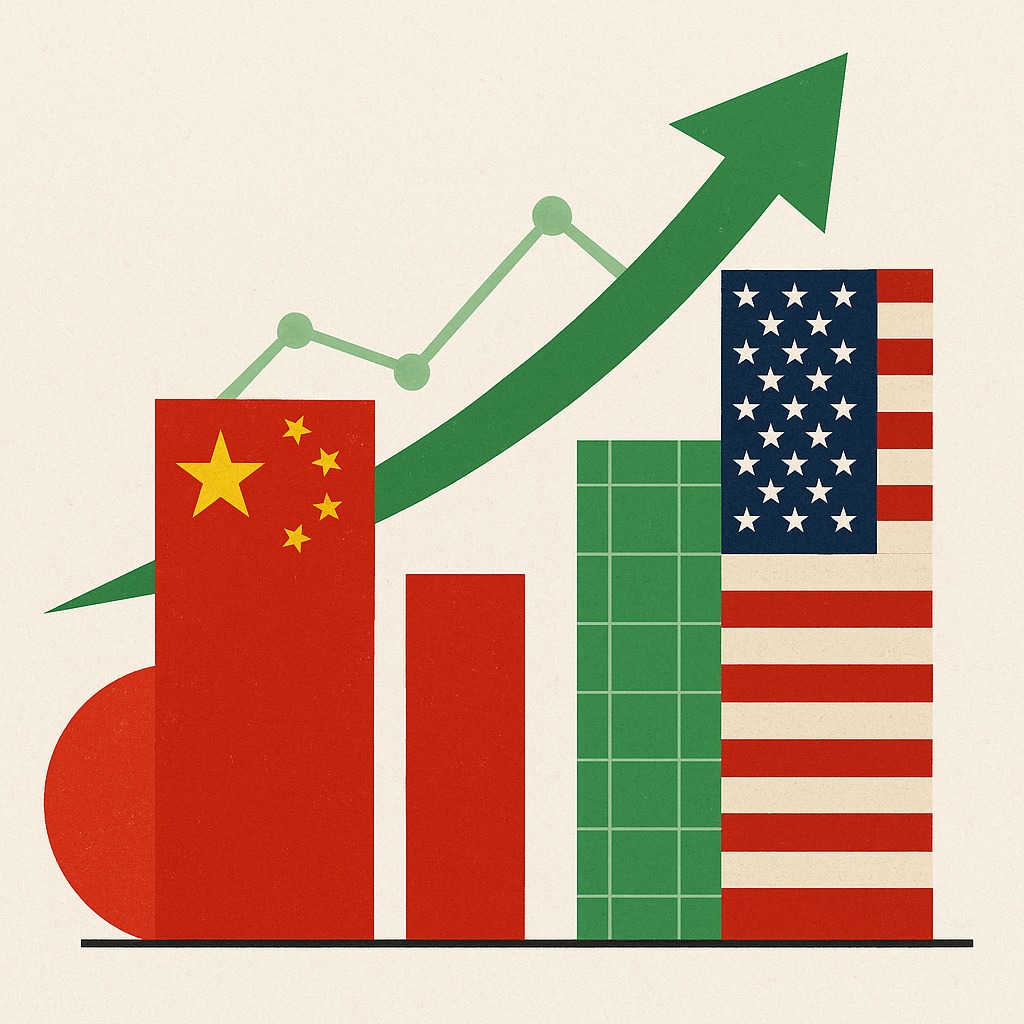
AI Industry Report Shows China Closing the AI Gap

A new annual State of AI report reveals that the global AI landscape is more competitive than ever. According to the analysis (from Stanford’s HAI), high-performing Chinese AI models have sharply increased in number and quality, rapidly challenging US leadership in the field. The performance edge between top American and Chinese models is now narrowing, as evidenced by benchmark tests and research output. Additionally, 2024 saw breakthrough progress in efficient AI systems, with smaller, optimized models matching the capabilities of previous large “behemoth” models. These trends indicate a tightening AI race, driven by China’s heavy R&D investments and talent growth. Experts say businesses worldwide should watch this evolving balance, as it may spur faster innovation and more diverse AI solutions.

SourceStanford HAI, MIT Technology Review
News 12
23 May 2025

Microsoft Empowers Businesses with Custom AI Agents

At its Build 2025 conference, Microsoft announced new tools for organizations to tailor AI to their needs. The company introduced Microsoft 365 Copilot “Tuning”, a low-code service that lets enterprises train Microsoft’s AI Copilot on their own data, workflows, and style guides. This enables companies to create domain-specific AI assistants – for example, a law firm can generate an agent that drafts documents in the firm’s preferred format and tone. Microsoft also unveiled multi-agent orchestration in Copilot Studio, allowing multiple specialized agents to collaborate on complex tasks. These updates, delivered within Microsoft’s secure cloud boundary, let businesses harness AI more accurately and securely.

SourceMicrosoft Blog, The Verge, Ars Technica
News 11
6 May 2025

IBM Integrates AI Agents and Invests $150 B in Tech Expansion

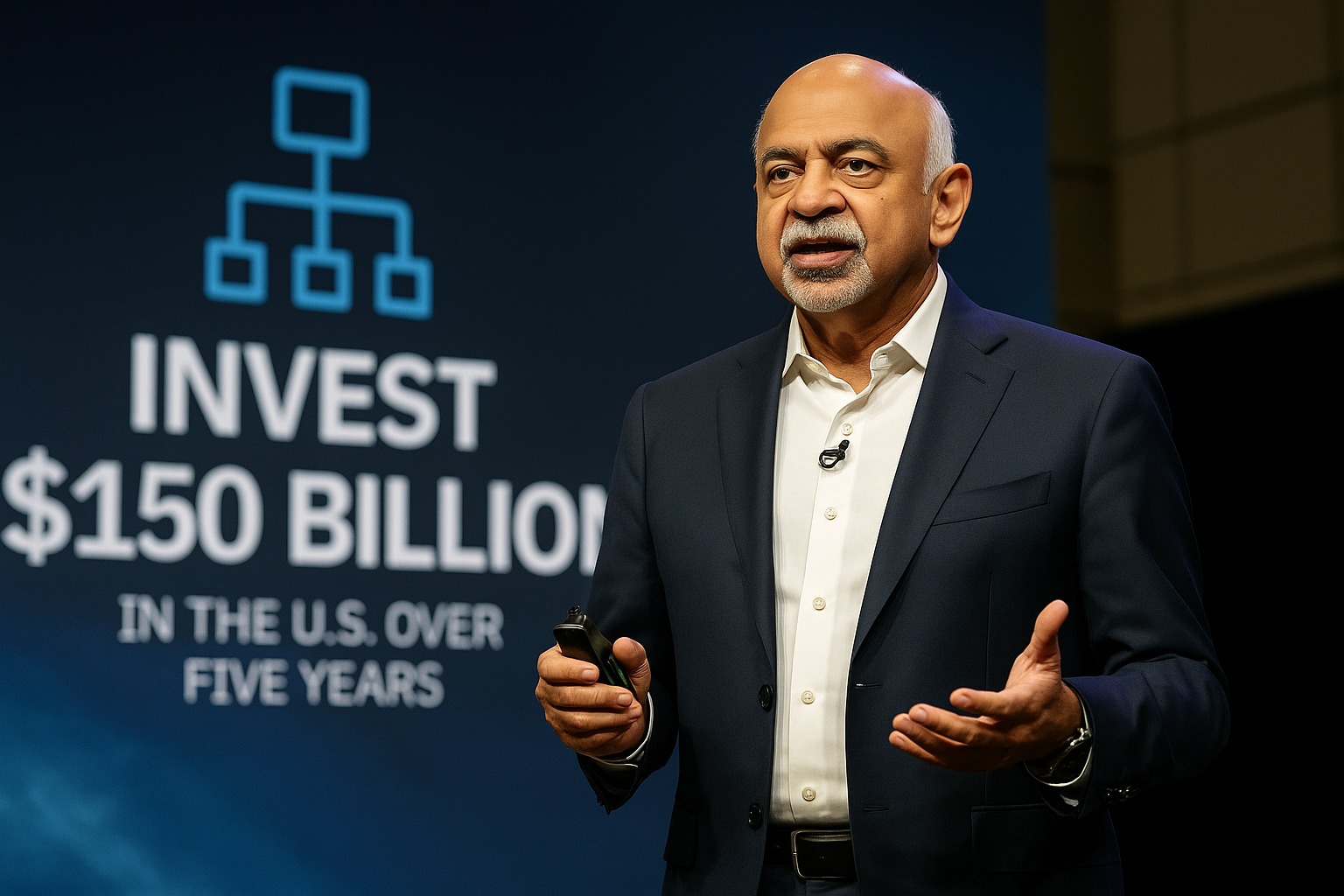
IBM is doubling down on enterprise AI with new integration tools and a major investment pledge. CEO Arvind Krishna outlined a strategy to help clients orchestrate fleets of AI “agents” – software bots from IBM and third-parties – across business applications. Unveiled at the annual IBM Think conference, the approach allows companies to plug in AI solutions from Salesforce, Workday, Adobe, and others into IBM’s platform, while quickly building their own agents using IBM’s Granite AI models. The company also announced it will invest $150 billion in the US over five years to strengthen its manufacturing and R&D in mainframes, artificial intelligence, and quantum computing.

SourceIBM Newsroom, CNBC, TechCrunch
News 10
10 April 2025

EU Issues Guidelines for Responsible Generative AI Research

The European Commission has published new guidelines on the responsible use of generative AI in research, aiming to foster ethics and transparency in scientific innovation. The recommendations emphasize four core principles for researchers: Reliability, Honesty, Respect, and Accountability. This means AI models used in research should be robust and unbiased, methods and data handling should be transparent and fair, and privacy, intellectual property, and human dignity must be safeguarded. Researchers are urged to clearly label AI-generated content and ensure human oversight in study design. These guidelines, while non-binding, are intended to shape responsible AI innovation in academic and applied fields.

SourceEuropean Commission, Nature, Science Business
News 9
9 April 2025

Google Unveils ‘Ironwood’ AI Chip Delivering 10× Performance

Google has revealed Ironwood, its seventh-generation Tensor Processing Unit (TPU) custom chip, designed to power the next wave of AI applications. Announced at the Google Cloud Next ’25 event, Ironwood is purpose-built for running advanced AI inference (“the age of inference”) with unprecedented scale and efficiency. A full Ironwood pod links 9,216 chips together to provide 42.5 exaflops of compute – over 24 times more processing power than the world’s largest supercomputer today. Google says Ironwood offers a 10× performance boost over its previous TPUs by improving energy efficiency and memory bandwidth.

SourceGoogle Cloud Blog, Wired, AnandTech
News 8
31 March 2025

Google Opens Advanced Gemini AI Model to All Users

Google has made its latest Gemini 2.5 Pro AI model – known for enhanced “reasoning” capabilities – freely available for anyone to try. This comes just days after the model’s preview release to paying subscribers. The Gemini 2.5 Pro incorporates step-by-step logical reasoning (“chain-of-thought”) that significantly improves performance on complex tasks. Google reports the model now leads on several language-model benchmarks. While usage is currently rate-limited, opening access widely marks a shift toward more inclusive AI development. Google also plans to integrate this advanced model into its mobile Gemini app and developer tools.

SourceGoogle DeepMind, TechCrunch, The Verge
News 7
5 March 2025

EU Updates Model Contracts to Ensure Trustworthy AI Procurement

The European Commission has released an updated set of Clauses for AI procurement (MCC-AI), giving public agencies a template to demand responsible AI practices from vendors. The clauses align with the EU’s draft AI Act, mirroring obligations for “high-risk” AI systems (e.g. in hiring or healthcare). They cover key areas such as risk assessment, data governance, transparency, human oversight, and cybersecurity measures. The MCC-AI package includes a full version for high-risk AI, a lighter version for lower-risk cases, and detailed guidance. While designed for public-sector contracts, these standards can be adopted by companies as well to foster compliance and trust.

SourceEuropean Commission, EUR-Lex, EU Digital Strategy Portal
News 6
February 15, 2025

Google Revises AI Ethics Guidelines

Google has updated its AI ethics principles, removing earlier explicit commitments to avoid certain high-risk applications. The new version emphasizes broader terms like “responsible AI” and “collaboration,” omitting previous categorical restrictions. According to Google, this shift is necessary to remain competitive and to support democratic values in the evolving AI ecosystem. Critics, however, argue that the changes weaken the company’s previous stance on harm prevention and transparency. The update reignites industry-wide debate on how ethical frameworks should be implemented and maintained.

News 5
February 1, 2025

EU’s AI Act Bans “Unacceptable Risk” Systems

On February 2, 2025, the EU AI Act officially begins enforcement of key restrictions on AI applications considered to pose an “unacceptable risk.” Banned systems include those that manipulate user behavior or implement harmful social scoring. Biometric surveillance in public is also prohibited. This regulation aims to preserve fundamental rights such as privacy and equality and sets a strong precedent for global AI governance. Companies that violate these rules face fines of up to 7% of global turnover.

News 4
January 15, 2025

OpenAI Plans $40 Billion Investment Round

OpenAI is planning a new $40 billion funding round, with SoftBank potentially contributing $25 billion. The funding would support a $500 billion initiative to build a next-generation AI infrastructure platform called “Stargate.” This project, aimed at scaling compute power for future AI models, highlights the intensifying race to build global AI capabilities. If finalized, the deal could mark one of the most significant AI infrastructure investments to date.

News 3
January 1, 2025

OpenAI Launches “o3-mini” Reasoning Model

OpenAI has released “o3-mini,” a streamlined AI model optimized for transparency and logic-based reasoning. It processes tasks about 24% faster than previous versions and includes visible step-by-step outputs. The model is available to free ChatGPT users with usage limits and can also be accessed via API. This release represents a shift toward more transparent, efficient AI models for both consumer and enterprise use cases.

News 2
December 15, 2024

Meta Fined €251 Million for GDPR Violation

Ireland’s data regulator has fined Meta €251 million following a long-standing privacy breach involving Facebook. The 2018 issue exposed personal data of 29 million users, including contact details and locations. Meta was found to have insufficiently implemented data protection measures and failed to report the breach transparently. This decision reinforces the EU’s strict enforcement of data compliance rules under GDPR.

SourceCNBC, heise.de
News 1
December 1, 2024

MIT Develops Fairness-Enhancing AI Training Method

Researchers at MIT have introduced a new method to reduce bias in machine learning models. The approach down-weights specific training data points that reduce performance for underrepresented groups, without degrading overall model accuracy. This method offers a targeted, scalable alternative to conventional dataset rebalancing and shows promise for enhancing fairness in real-world AI deployments.